These records are found in the online catalog of The Mariners’ Museum and Park in Newport News, Virginia. Uncurated search results are presented to give researchers and interested readers an idea of whether the museum’s archives contain information about this vessel and whether it may be worthwhile to visit the museum’s catalog search page for further investigation. Uncurated results may be inaccurate or incomplete.
Mariners Museum online catalog search, July 12, 2026. Search phrase: "Infanta". Catalog returned 29 records; this selection table includes 29 records fetched through catalog result pages.
Use these buttons to send uncurated search results to your own app or text document for further research. First, check the box for any row, or click "Select All" then uncheck any rows. Then click "Show Selections". You can then copy your selections from the text box and past them into your app.
LABEL ON VERSO: NEG. 217 "INFANTA" 47 FT. YAWL DESIGNED BY PHILIP L. RHODES AND BUILT BY KRETZER BOAT WORKS, CITY ISLAND, N.Y. IN 1948. C 1950
CURATOR NOTES: A large two mast sailboat showing its port side and a dinghy off the stern. The dinghy also appears to be a small sailboat. The water is flat. The scene has no horizon due to fog. There is an object left of the boat in the background that could be land or a barge. The sky is partly over cast.
Warships–United States.; Warships–Spain.; Steamboats–United States.
Shows a starboard side view of a Spanish warship, her flags and ensigns flying in the air. Stanton's notebooks contain the following information about this item: "Apl 27 1897"
Warships–United States.; Warships–Spain.; Steamboats–United States.
Shows a starboard side view of a Spanish warship, her flags and ensigns flying. Stanton's notebooks contain the following information about this item: "Apl 27 1897"
INFANTA MARIA TERESA (ARMOURED CRUISER: 1890-1898)
RELATED PLACE: CUBA, SANTIAGO
SHORT DESCRIPTION: Cutlass: slight up sweep blade style with beak point. The blade is heavily painted. Hilt made of brass with a sheet steel knuckle guard. The pommel style is bird's head. The grip is cast iron with a ribbed pattern. NOTES: This object from the Spanish Cruiser INFANTA MARIA TERESA, Santiago-de-Cuba, July 1898 WEAPON INFORMATION - L.O.A.: 34.500 (876.30 mm) BLADE WIDTH: 1.375 (34.93 mm) BLADE LENGTH:29.188 (mm) BLADE THICKNESS: .313 (7.95mm) BLADE FINISH: BLADE STYLE: slight upsweep POINT STYLE: beak SOCKET BORE (M/R): HILT LENGTH: 5.250 (133.35 mm) HILT MATERIAL: 5.250 (133.35 mm) GRIP MATERIAL: steel BLADE NOTES: HILT NOTES: Knuckle guard sheet steel GRIP NOTES: Cast iron (casting seams evident) ribbed pattern POMMEL STYLE: Bird's head SIGNIFICANT HISTORY: Claimed to have been from a Spanish Cruiser, INFANTA MARIA TERESA, Santiago-de-Cuba, July 18989 (se also AK 179) (Edged Weapons Collection Survey by Chuck Williamson, November, 1996)
LABEL COPY: Shell from Infanta Maria Theresa, Flagship of Admiral Cervera, 1898. NOTE: See accession file for EOD information. NOTE: The shell’s top and bottom can be detached from one another. They are NOT recorded as component parts.
INFANTA MARIA TERESA (ARMOURED CRUISER: 1890-1898)
SHORT DESCRIPTION: Plaque with Royal Coat of Arms of Spain which ornamented the turret of the Spanish flagship, cruiser INFANTA MARIA TERESA which was captured in the battle of July 3, 1898 off Santiago.
INFANTA MARIA TERESA (ARMOURED CRUISER: 1890-1898)
RELATED PLACE: SPAIN, BILBAO
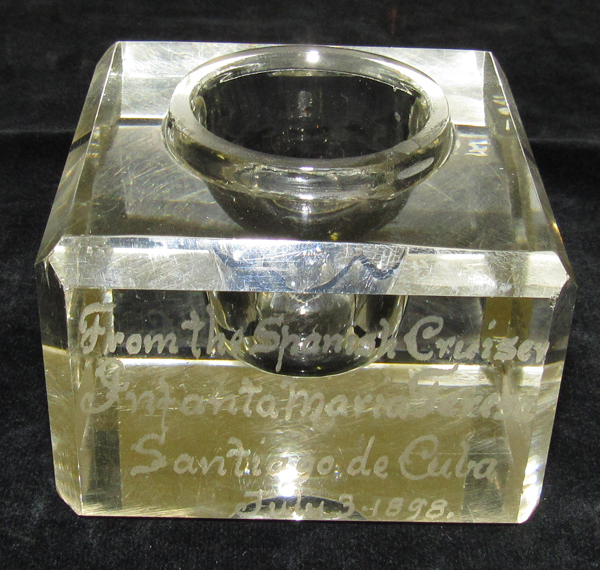
NOTES: This spoon was taken from Admiral Cervera's cabin on the Spanish warship INFANTA MARIA TERESA by Captain Henry Williams at the time of the Battle of Santiago, July 3, 1898. VESSEL INFORMATION - VESSEL NAME: INFANTA MARIA TERESA VESSEL TYPE: ARMORED CRUISER VESSEL BUILT: 1890 VESSEL LOCATION: BILBAO, SPAIN VESSEL DIMENSIONS: 6,890 tons; 364'(340') x 65'2" x 21'6" VESSEL HISTORY: She was destroyed off Santiago on July 3, 1898.
INFANTA MARIA TERESA (ARMOURED CRUISER: 1890-1898)
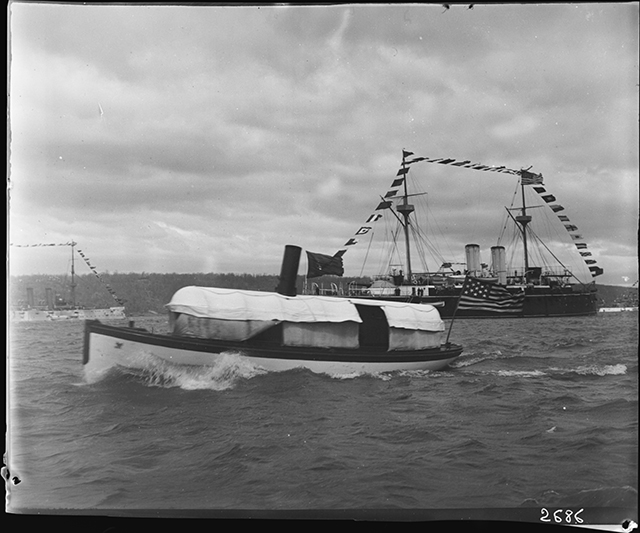
Launch - (U.S.N.) Maria Teresa - (Sp. cruiser); 2686
Steamboats–United States.; Tugboats–United States.; Government vessels–United States.; Warships–Spain.
Shows a port side view of the stern of a small steamboat making way with a Spanish warship in the background. Stanton's notebooks contain the following information about this item: "Apl 27 1897"
VESSEL INFORMATION - VESSEL NAME: Infanta Maria Teresa VESSEL DATES: 1890-1898 DATE WRECKED: July 3, 1898 VESSEL HISTORY: Beached and destroyed during the Battle of Santiago de Cuba, July 3, 1898 MAJOR EVENT: Spanish-American War, Battle of Santiago de Cuba VESSEL DIMENSIONS: 350 ft long; sea speed 15 knots
PENNSYLVANIA, PHILADELPHIA; RELATED PLACE: CUBA, SANTIAGO
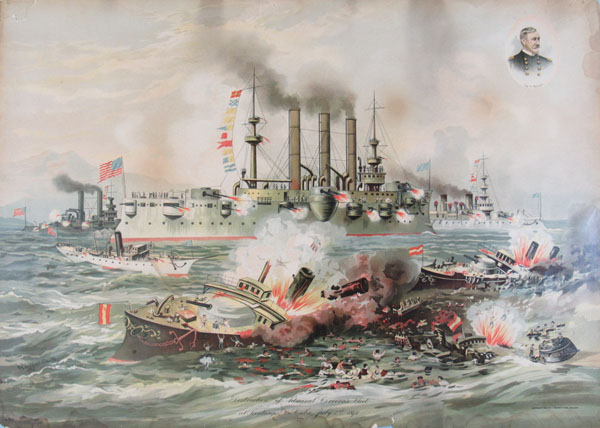
SHORT DESCRIPTION: Color lithograph depicting the destruction of Admiral Cervera's Fleet at Santiago de Cuba on July 3rd, 1898. One of the ships depicted is either the USS OREGON or USS INDIANA. There is also an inset portrait of W.S Schley in the upper right corner. LABEL COPY: Battle of Santiago/3 July 1898/haste to do now what must be done anon/Or some mad hope of selling triumph dear/Drive the ships forth: soon was INFANTA MARIA TERESA gone/FUROR, PLUTON, VIZCAYA, ALMIRANTE OQUENDO, and CRISTOBAL COLON./From "Spain in America" in POEMS/by George Santayana/On 3 July 1898 the Spanish fleet under Admiral Cervera attempted to break out of the American blockade of Santiago Bay. Within a few hours all of Cervera's squadron was sunk or stranded by the United States Navy under Admiral Sampson and Commodore Schley. Her naval power crushed, Spain was forced to sue for peace at the end of July. America's "New Navy" had presided over the conquest of Cuba and the expulsion of Spain from the Western Hemisphere. VESSEL INFORMATION - VESSEL NAME: VIZCAYA VESSEL TYPE: Infanta Maria Teresa-class armored cruiser BUILDER LOCATION: SPAIN, BILBAO BUILD DATE: 1890-1891 SHIPOWNER: SPANISH NAVY VESSEL DIMENSIONS: 7000 tons, 340 x 65 x 21.6 FATE: Sunk at the Battle of Santiago, July 3, 1898. VESSEL HISTORY: Vizcaya was an armored cruiser of the Spanish Navy that fought at the Battle of Santiago de Cuba during the Spanish-American War. She was laid down in 1889, launched on 8 July 1891, and completed in 1893.
SHORT DESCRIPTION: This flag briefly flew over two captured Spanish vessels during the Spanish American War (the gunboat SANDOVAL and Admiral Pascual Cervera's flagship INFANTA MARIA TERESA.) In both instances, the flag was hoisted by the tugboat U.S.S. POTOMAC which assisted in the raising and towing of the two vessels. The U.S.S. POTOMAC was commanded by Lt. George Preston Blow. NOTES: George Preston Blow was born in Norfolk, Virginia in 1860. He was enrolled in the United States Naval Academy at the age of 15 (one of the first southerners allowed to matriculate after the Civil War) and graduated in 1881. Shortly after his graduation he was a member of the volunteer crew of the USS Pinta on its controversial trip from Norfolk to Alaska via Cape Horn in 1883. He later served on the USS Pensacola under Captain George Dewey in the Mediterranean. In 1887 he was appointed navigation officer for the attempts to raise the DeBraak in Delaware Bay. In 1890 as aide to Admiral Brown, he was detailed to King Kalakaua of Hawaii during the king's fatal visit to California and was later knighted by Queen Liliuokalani (although he was not authorized by Congress to accept the honor until March, 1887. The decoration was forwarded to him by the Navy Department, and was lost on the USS Maine along with everything else he had on board.) He was assigned as a Lieutenant to the USS Texas in 1895 and USS Maine in 1896 at the age of 36. After surviving the explosion of the Maine on February 15, 1898 he served (during the Spanish American War) as a Commander and later Captain. He was in command of the USS Potomac which assisted in raising the Spanish flagship Infanta Maria Theresa, sunk in the battle of Santiago Bay, and later commanded the USS Vulcan, which was towing the Spanish warship to the United States when it was lost in a gale near Cat Island in the Bahamas. During his naval career he also established the U.S. Hydrographic bureaus in Cleveland and Chicago and was credited with inventing several naval devices including the depth-charge. He died in Washington, D.C. in 1922. NOTES: David Dick, 8/16/2002 The story of the flag from the INFANTA MARIA THERESA is fairly well covered in the Naval History article. I have underlined in red pencil the sequence of events. The summation is: During the Spanish American War, circa, June 1898, five Spanish vessels including the MARIA TERESA were driven ashore in Cuba. The status of these beached vessels was found that the MARIA THERESA was salvageable. On September 23rd, 1898, the vessel was towed off the beach and was made ready for towing to Norfolk for further repairs and modification for future use by the navy. The U.S. flag was run up the mast and the vessel was renamed TERESA. It ship was never commissioned by the Navy. On October 29, 1898, the three boats towed (MERRITT, VULCAN and TERESA) left for Norfolk. From the start, the weather was fairly windy but the convoy managed. However, on November 1, 1898, the convoy was hit by a tropical storm. Finally it was necessary to cut the vessels from the tow, at this high pitch of the storm, it was noted that the U.S. flag was still flying. The TERESA ended up on Cat Island, Bahamas. According to the naval history article, it is still there. VESSEL INFORMATION - VESSEL NAME: INFANTA MARIA TERESA VESSEL TYPE: Cruiser VESSEL LAID DOWN: 1889 VESSEL LAUNCHED: 1890 COMPLETED: 1893 SHIPBUILDER: SOCIEDAD ASTILLEROS DEL NERVION BUILDER LOCATION: BILBAO, SPAIN VESSEL HISTORY: She was a modern and speedy first class cruiser. However, the level of training and maintenance in the Spanish fleet was not what it should have been, and the TERESA, like all of Cervara's ships, went to war at less than full efficiency. She was in need of dry-docking and short of ammunition. Even some of her guns were not opera table. Also, like all warships of the era, she was heavily decorated and furnished with wood. The US Navy stripped this flammable material off its vessels at the beginning of the conflict, but the Spanish failed to do so, making the Teresa and her fleet-mates seriously susceptible to fire. ADDITIONAL INFORMATION: See "Maine, A Ship to Remember, by Michael Blow and Naval History, February 2002 issue, page 26 (for article see object file).
Santiago, Battle of, Santiago de Cuba, Cuba, 1898.; Spanish-American War, 1898–Naval operations, American.
The collection consists of 8 pages of a 12-page letter written by Henry Williams to his father. In the letter Williams describes the hulk of the beached Spanish flagship Infanta Maria Teresa after the Battle of Santiago de Cuba during the Spanish-American War. Infanta Maria Teresa had been severely damaged by US naval gunfire. He also writes about the destruction US gunners inflicted on the rest of the Spanish fleet during the battle. The letter mentions possible future plans for his ship USS Massachusetts and the problem with receiving news and mail late.
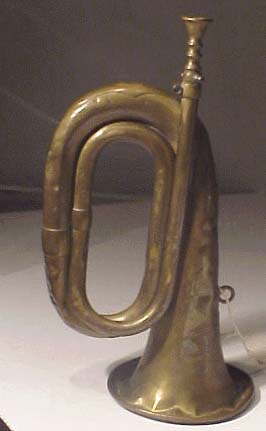
SHORT DESCRIPTION: Brass bugle from the Spanish ship VIZCAYA, which was captured on July 3, 1898. VESSEL INFORMATION - VESSEL NAME: VIZCAYA VESSEL TYPE: Infanta Maria Teresa-class armored cruiser BUILDER LOCATION: SPAIN, BILBAO BUILD DATE: 1890-1891 SHIPOWNER: SPANISH NAVY VESSEL DIMENSIONS: 7000 tons, 340 x 65 x 21.6 FATE: Sunk at the Battle of Santiago, July 3, 1898. VESSEL HISTORY: Vizcaya was an armored cruiser of the Spanish Navy that fought at the Battle of Santiago de Cuba during the Spanish-American War. She was laid down in 1889, launched on 8 July 1891, and completed in 1893.
Twelve-page letter from Henry Williams to his father Thomas Williams. He describes the wreck of the Spanish flag ship Infanta María Theresa, and the destruction of the Vizcaya and Oquendo. He praises the accuracy of the gunners and credits them with the defeat of the Spanish ships. He writes that they are excited because his ship USS Massachusetts (BB-2) may be ordered to Manila. He also describes the end of the Battle of Santiago de Cuba. They get their mail and news a few weeks later than everybody else.
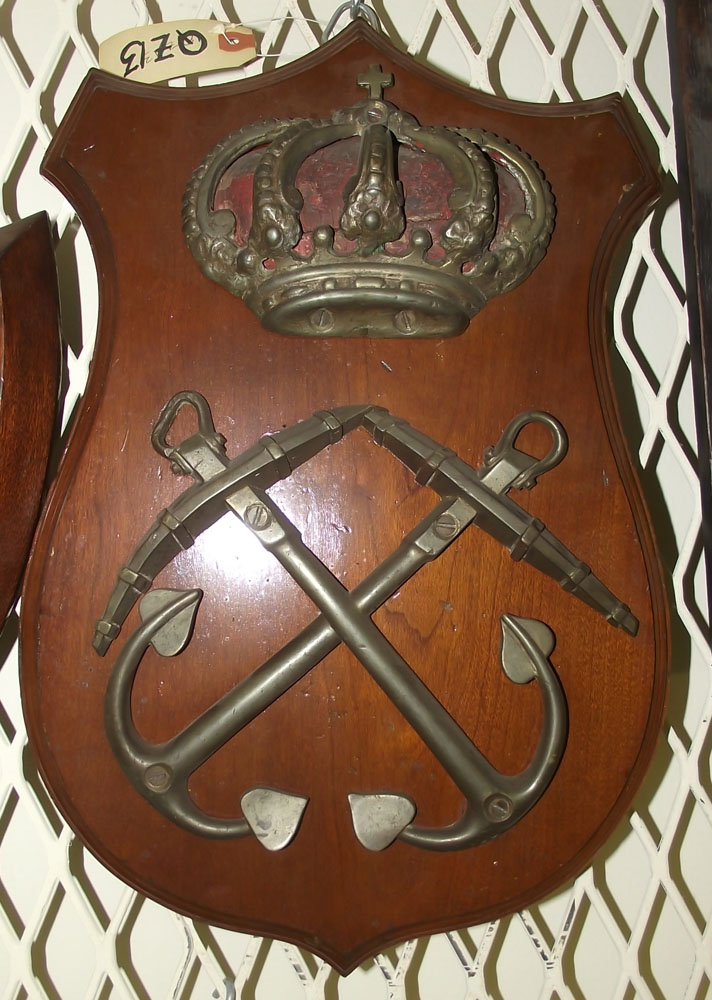
SHORT DESCRIPTION: Crown and anchor decoration from Spanish cruiser VIZCAYA. NOTES: It is possible that the crossed anchors and crown were recovered from the vessel and the plaque is a later device added to display the items. VESSEL INFORMATION - VESSEL NAME: VIZCAYA VESSEL TYPE: Infanta Maria Teresa-class armored cruiser BUILDER LOCATION: SPAIN, BILBAO BUILD DATE: 1890-1891 SHIPOWNER: SPANISH NAVY VESSEL DIMENSIONS: 7000 tons, 340 x 65 x 21.6 FATE: Sunk at the Battle of Santiago, July 3, 1898. VESSEL HISTORY: Vizcaya was an armored cruiser of the Spanish Navy that fought at the Battle of Santiago de Cuba during the Spanish-American War. She was laid down in 1889, launched on 8 July 1891, and completed in 1893.
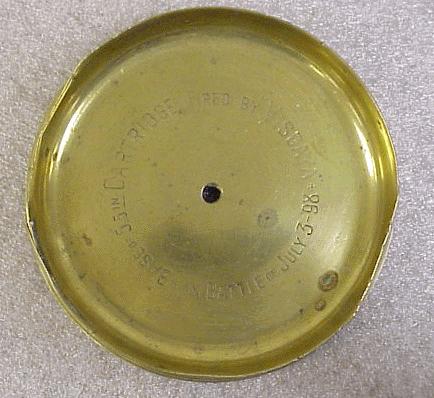
NOTES: Cartridge base was supposedly recovered by Lt. George Preston Blow a division officer aboard the U.S.S. MAINE who, following the destruction of the MAINE, went on to serve in the American squadron blockading Cuba in the summer of 1898. NOTES: George Preston Blow was born in Norfolk, Virginia in 1860. He was enrolled in the United States Naval Academy at the age of 15 (one of the first southerners allowed to matriculate after the Civil War) and graduated in 1881. Shortly after his graduation he was a member of the volunteer crew of the USS Pinta on its controversial trip from Norfolk to Alaska via Cape Horn in 1883. He later served on the USS Pensacola under Captain George Dewey in the Mediterranean. In 1887 he was appointed navigation officer for the attempts to raise the DeBraak in Delaware Bay. In 1890 as aide to Admiral Brown, he was detailed to King Kalakaua of Hawaii during the king's fatal visit to California and was later knighted by Queen Liliuokalani (although he was not authorized by Congress to accept the honor until March, 1887. The decoration was forwarded to him by the Navy Department, and was lost on the USS Maine along with everything else he had on board.) He was assigned as a Lieutenant to the USS Texas in 1895 and USS Maine in 1896 at the age of 36. After surviving the explosion of the Maine on February 15, 1898 he served (during the Spanish American War) as a Commander and later Captain. He was in command of the USS Potomac which assisted in raising the Spanish flagship Infanta Maria Theresa, sunk in the battle of Santiago Bay, and later commanded the USS Vulcan, which was towing the Spanish warship to the United States when it was lost in a gale near Cat Island in the Bahamas. During his naval career he also established the U.S. Hydrographic bureaus in Cleveland and Chicago and was credited with inventing several naval devices including the depth-charge. He died in Washington, D.C. in 1922. VESSEL INFORMATION - VESSEL NAME: VIZCAYA VESSEL TYPE: Infanta Maria Teresa-class armored cruiser BUILDER LOCATION: SPAIN, BILBAO BUILD DATE: 1890-1891 SHIPOWNER: SPANISH NAVY VESSEL DIMENSIONS: 7000 tons, 340 x 65 x 21.6 FATE: Sunk at the Battle of Santiago, July 3, 1898. VESSEL HISTORY: Vizcaya was an armored cruiser of the Spanish Navy that fought at the Battle of Santiago de Cuba during the Spanish-American War. She was laid down in 1889, launched on 8 July 1891, and completed in 1893.
SHORT DESCRIPTION: Three-bladed bronze propeller from a torpedo launch of the Spanish armored cruiser ALMIRANTE OQUENDO. The hub of the wheel is about 7" long with a bore on forward end 2-7/8" aft and 2-3/8". One blade is bent about 90 degrees and has a kink near the root. VESSEL INFORMATION: VESSEL HISTORY: Almirante Oquendo, a 6890-ton Infanta Maria Teresa class armored cruiser, was launched at Bilbao, Spain, in October 1891. A unit of Admiral Cervera's Spanish-American War squadron, she was wrecked by gunfire in the Battle of Santiago, Cuba, on 3 July 1898. Classification: Belted Cruiser Laid down: January, 1889 Launched: April 10, 1891 Completed: 1893 Rig: Two military masts Armament: Two 28 cm Hontoria breechloading guns (11 inch) Ten 14 cm Hontoria Quick firing guns (5.5 inch) Eight 57 mm Hotchkiss Quick firing guns (3 pounder) Eight 37 mm revolving Hotchkiss revolving guns (1 pounder) Two 22 mm Nordenfelt machine guns Two 2.75 inch bronze guns (for landing parties?) Eight 365 mm tordedo tubes Contractor: Sociedad Astilleros del Nervión of Sestao,s upported by Brown of Sheffield (UK) Length: 366 feet, 8 inches (111.8 meters) Beam: 65 feet (19.81 meters) Mean draft: 21 feet, 6 inches (6.55 meters) Displacement: 6,890 tons Complement: 497 Officers and Men, under the command of CaptainLagaza Engine type: 13,700 hp. vertical triple expansion engines, twin screws. Speed: 20 knots Coal bunker capacity: 1,050 tons Coal endurance @ 10 knots: 9,700 miles Armor: 254-305 mm (10 -12 inch) steel side belt, 229 mm barbettes, 51-76 mm (2-3 inch) deck.
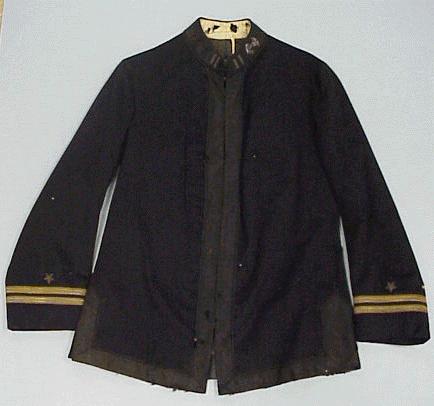
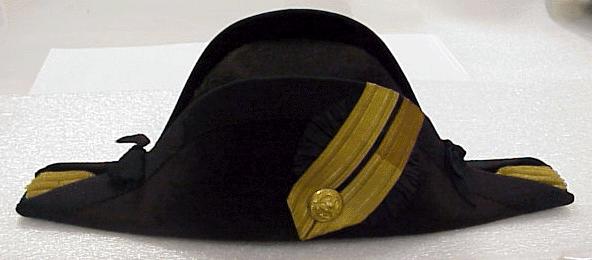
SHORT DESCRIPTION: Officer's service dress blue tunic, Lieutenant insignia. Worn by Lt. George Preston Blow. NOTES: In the attached photograph from the Naval History and Heritage Command Blow appears to be wearing this uniform. NOTES: George Preston Blow was born in Norfolk, Virginia in 1860. He was enrolled in the United States Naval Academy at the age of 15 (one of the first southerners allowed to matriculate after the Civil War) and graduated in 1881. Shortly after his graduation he was a member of the volunteer crew of the USS Pinta on its controversial trip from Norfolk to Alaska via Cape Horn in 1883. He later served on the USS Pensacola under Captain George Dewey in the Mediterranean. In 1887 he was appointed navigation officer for the attempts to raise the DeBraak in Delaware Bay. In 1890 as aide to Admiral Brown, he was detailed to King Kalakaua of Hawaii during the king's fatal visit to California and was later knighted by Queen Liliuokalani (although he was not authorized by Congress to accept the honor until March, 1887. The decoration was forwarded to him by the Navy Department, and was lost on the USS Maine along with everything else he had on board.) He was assigned as a Lieutenant to the USS Texas in 1895 and USS Maine in 1896 at the age of 36. After surviving the explosion of the Maine on February 15, 1898 he served (during the Spanish American War) as a Commander and later Captain. He was in command of the USS Potomac which assisted in raising the Spanish flagship Infanta Maria Theresa, sunk in the battle of Santiago Bay, and later commanded the USS Vulcan, which was towing the Spanish warship to the United States when it was lost in a gale near Cat Island in the Bahamas. During his naval career he also established the U.S. Hydrographic bureaus in Cleveland and Chicago and was credited with inventing several naval devices including the depth-charge. He died in Washington, D.C. in 1922.
NOTES: George Preston Blow was born in Norfolk, Virginia in 1860. He was enrolled in the United States Naval Academy at the age of 15 (one of the first southerners allowed to matriculate after the Civil War) and graduated in 1881. Shortly after his graduation he was a member of the volunteer crew of the USS Pinta on its controversial trip from Norfolk to Alaska via Cape Horn in 1883. He later served on the USS Pensacola under Captain George Dewey in the Mediterranean. In 1887 he was appointed navigation officer for the attempts to raise the DeBraak in Delaware Bay. In 1890 as aide to Admiral Brown, he was detailed to King Kalakaua of Hawaii during the king's fatal visit to California and was later knighted by Queen Liliuokalani (although he was not authorized by Congress to accept the honor until March, 1887. The decoration was forwarded to him by the Navy Department, and was lost on the USS Maine along with everything else he had on board.) He was assigned as a Lieutenant to the USS Texas in 1895 and USS Maine in 1896 at the age of 36. After surviving the explosion of the Maine on February 15, 1898 he served (during the Spanish American War) as a Commander and later Captain. He was in command of the USS Potomac which assisted in raising the Spanish flagship Infanta Maria Theresa, sunk in the battle of Santiago Bay, and later commanded the USS Vulcan, which was towing the Spanish warship to the United States when it was lost in a gale near Cat Island in the Bahamas. During his naval career he also established the U.S. Hydrographic bureaus in Cleveland and Chicago and was credited with inventing several naval devices including the depth-charge. He died in Washington, D.C. in 1922.
SHORT DESCRIPTION: Anchor light with clear Fresnel lens globe. NOTES: This item is from the Spanish cruiser VIZCAYA, which was sunk during the Battle of Santiago on July 3, 1898. This item was obtained by Assistant Engineer (later Captain) Kenneth McAlpine of the USS TEXAS. VESSEL INFORMATION - VESSEL NAME: VIZCAYA VESSEL TYPE: Infanta Maria Teresa-class armored cruiser BUILDER LOCATION: SPAIN, BILBAO BUILD DATE: 1890-1891 SHIPOWNER: SPANISH NAVY VESSEL DIMENSIONS: 7000 tons, 340 x 65 x 21.6 FATE: Sunk at the Battle of Santiago, July 3, 1898. VESSEL HISTORY: Vizcaya was an armored cruiser of the Spanish Navy that fought at the Battle of Santiago de Cuba during the Spanish-American War. She was laid down in 1889, launched on 8 July 1891, and completed in 1893. VESSEL INFORMATION: VESSEL NAME: USS TEXAS VESSEL TYPE: Battleship BUILDER: Norfolk Navy Yard BUILDER LOCATION: Norfolk, Virginia VESSEL BUILT: 1892 SERVICE DATES: 1892-1911 VESSEL HISTORY: USS Texas was a second-class battleship built by the United States in the early 1890s, the first American battleship commissioned. USS Texas was launched June 28, 1892 from the Norfolk Navy Yard in Portsmouth, Virginia. The ship joined the North Atlantic Squadron until 1898, when the Spanish-American War broke out. Texas became part of Commodore Winfield Scott Schley’s Flying Squadron, a fleet of vessels initially consisting of battleships USS Massachusetts and USS Texas, armored cruiser USS Brooklyn, and protected cruisers USS Minneapolis and USS Columbia. Their goal was to protect the east coast against a possible attack by Spain. While off Cuba, Texas patrolled around Cienfuegos, Santiago, and Guantanamo. Texas was heavily involved in the Battle of Santiago, helping to defeat the Spanish fleet. After the war, Texas patrolled the east coast. The name changed to USS San Marcos to allow the Texas name to be reassigned to Battleship hull no. 35., and the ship was eventually sunk for target practice. VESSEL DIMENSIONS: 308'10" x 64'1" x 22'6" FATE: Sunk for target practice in the Chesapeake Bay, 1912 Alternate vessel names: (1) USS TEXAS (1895-1911); (2) USS SAN MARCOS (1911-1912)
NOTES: George Preston Blow was born in Norfolk, Virginia in 1860. He was enrolled in the United States Naval Academy at the age of 15 (one of the first southerners allowed to matriculate after the Civil War) and graduated in 1881. Shortly after his graduation he was a member of the volunteer crew of the USS Pinta on its controversial trip from Norfolk to Alaska via Cape Horn in 1883. He later served on the USS Pensacola under Captain George Dewey in the Mediterranean. In 1887 he was appointed navigation officer for the attempts to raise the DeBraak in Delaware Bay. In 1890 as aide to Admiral Brown, he was detailed to King Kalakaua of Hawaii during the king's fatal visit to California and was later knighted by Queen Liliuokalani (although he was not authorized by Congress to accept the honor until March, 1887. The decoration was forwarded to him by the Navy Department, and was lost on the USS Maine along with everything else he had on board.) He was assigned as a Lieutenant to the USS Texas in 1895 and USS Maine in 1896 at the age of 36. After surviving the explosion of the Maine on February 15, 1898 he served (during the Spanish American War) as a Commander and later Captain. He was in command of the USS Potomac which assisted in raising the Spanish flagship Infanta Maria Theresa, sunk in the battle of Santiago Bay, and later commanded the USS Vulcan, which was towing the Spanish warship to the United States when it was lost in a gale near Cat Island in the Bahamas. During his naval career he also established the U.S. Hydrographic bureaus in Cleveland and Chicago and was credited with inventing several naval devices including the depth-charge. He died in Washington, D.C. in 1922. INVENTORY: hat case - there is one (1) component part.
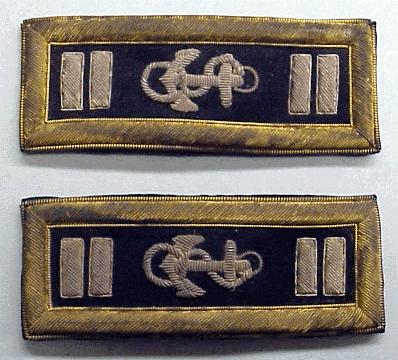
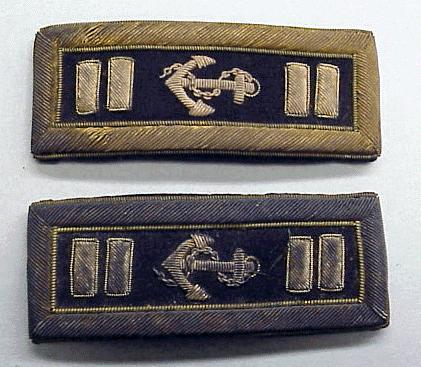
NOTES: George Preston Blow was born in Norfolk, Virginia in 1860. He was enrolled in the United States Naval Academy at the age of 15 (one of the first southerners allowed to matriculate after the Civil War) and graduated in 1881. Shortly after his graduation he was a member of the volunteer crew of the USS Pinta on its controversial trip from Norfolk to Alaska via Cape Horn in 1883. He later served on the USS Pensacola under Captain George Dewey in the Mediterranean. In 1887 he was appointed navigation officer for the attempts to raise the DeBraak in Delaware Bay. In 1890 as aide to Admiral Brown, he was detailed to King Kalakaua of Hawaii during the king's fatal visit to California and was later knighted by Queen Liliuokalani (although he was not authorized by Congress to accept the honor until March, 1887. The decoration was forwarded to him by the Navy Department, and was lost on the USS Maine along with everything else he had on board.) He was assigned as a Lieutenant to the USS Texas in 1895 and USS Maine in 1896 at the age of 36. After surviving the explosion of the Maine on February 15, 1898 he served (during the Spanish American War) as a Commander and later Captain. He was in command of the USS Potomac which assisted in raising the Spanish flagship Infanta Maria Theresa, sunk in the battle of Santiago Bay, and later commanded the USS Vulcan, which was towing the Spanish warship to the United States when it was lost in a gale near Cat Island in the Bahamas. During his naval career he also established the U.S. Hydrographic bureaus in Cleveland and Chicago and was credited with inventing several naval devices including the depth-charge. He died in Washington, D.C. in 1922. INVENTORY: two epaulet - there are two (2) component parts.
NOTES: George Preston Blow was born in Norfolk, Virginia in 1860. He was enrolled in the United States Naval Academy at the age of 15 (one of the first southerners allowed to matriculate after the Civil War) and graduated in 1881. Shortly after his graduation he was a member of the volunteer crew of the USS Pinta on its controversial trip from Norfolk to Alaska via Cape Horn in 1883. He later served on the USS Pensacola under Captain George Dewey in the Mediterranean. In 1887 he was appointed navigation officer for the attempts to raise the DeBraak in Delaware Bay. In 1890 as aide to Admiral Brown, he was detailed to King Kalakaua of Hawaii during the king's fatal visit to California and was later knighted by Queen Liliuokalani (although he was not authorized by Congress to accept the honor until March, 1887. The decoration was forwarded to him by the Navy Department, and was lost on the USS Maine along with everything else he had on board.) He was assigned as a Lieutenant to the USS Texas in 1895 and USS Maine in 1896 at the age of 36. After surviving the explosion of the Maine on February 15, 1898 he served (during the Spanish American War) as a Commander and later Captain. He was in command of the USS Potomac which assisted in raising the Spanish flagship Infanta Maria Theresa, sunk in the battle of Santiago Bay, and later commanded the USS Vulcan, which was towing the Spanish warship to the United States when it was lost in a gale near Cat Island in the Bahamas. During his naval career he also established the U.S. Hydrographic bureaus in Cleveland and Chicago and was credited with inventing several naval devices including the depth-charge. He died in Washington, D.C. in 1922. INVENTORY: two epaulet - there are two (2) component parts.
MARYLAND, BALTIMORE; RELATED PLACE: MARYLAND, ANNAPOLIS
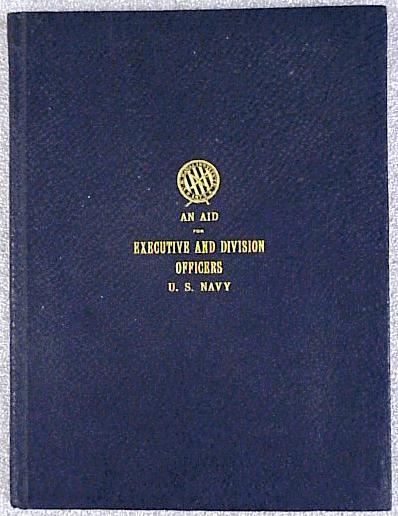
NOTES: This manual of blank forms was purchased and owned by Lt. George Preston Blow but was never used. NOTES: George Preston Blow was born in Norfolk, Virginia in 1860. He was enrolled in the United States Naval Academy at the age of 15 (one of the first southerners allowed to matriculate after the Civil War) and graduated in 1881. Shortly after his graduation he was a member of the volunteer crew of the USS Pinta on its controversial trip from Norfolk to Alaska via Cape Horn in 1883. He later served on the USS Pensacola under Captain George Dewey in the Mediterranean. In 1887 he was appointed navigation officer for the attempts to raise the DeBraak in Delaware Bay. In 1890 as aide to Admiral Brown, he was detailed to King Kalakaua of Hawaii during the king's fatal visit to California and was later knighted by Queen Liliuokalani (although he was not authorized by Congress to accept the honor until March, 1887. The decoration was forwarded to him by the Navy Department, and was lost on the USS Maine along with everything else he had on board.) He was assigned as a Lieutenant to the USS Texas in 1895 and USS Maine in 1896 at the age of 36. After surviving the explosion of the Maine on February 15, 1898 he served (during the Spanish American War) as a Commander and later Captain. He was in command of the USS Potomac which assisted in raising the Spanish flagship Infanta Maria Theresa, sunk in the battle of Santiago Bay, and later commanded the USS Vulcan, which was towing the Spanish warship to the United States when it was lost in a gale near Cat Island in the Bahamas. During his naval career he also established the U.S. Hydrographic bureaus in Cleveland and Chicago and was credited with inventing several naval devices including the depth-charge. He died in Washington, D.C. in 1922.
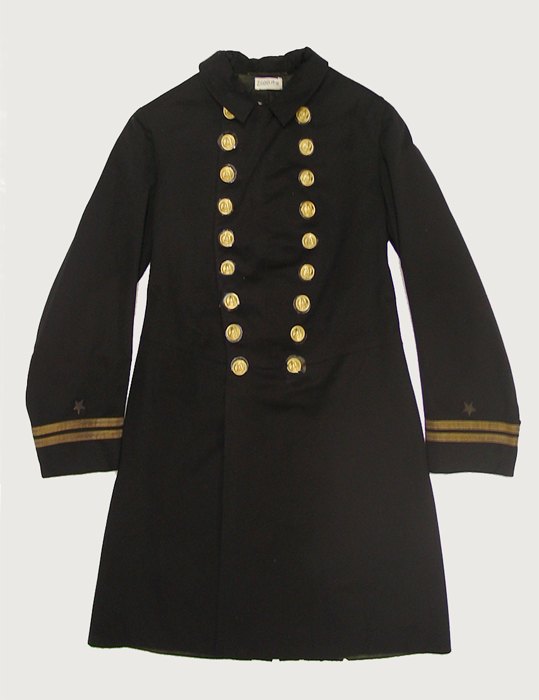
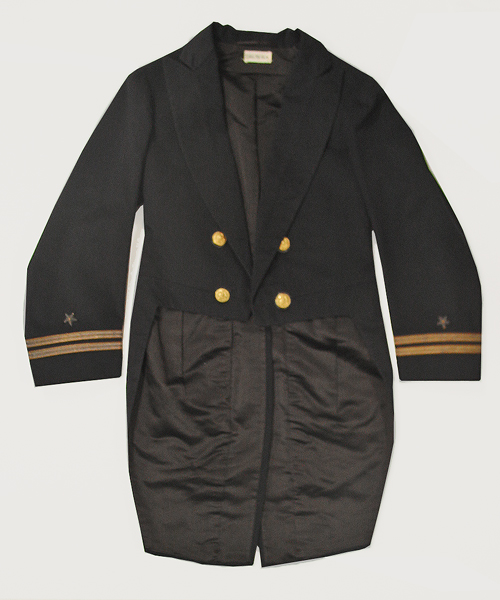
SHORT DESCRIPTION: U.S. Navy officer's evening dress blue coat and waistcoat. NOTES: George Preston Blow was born in Norfolk, Virginia in 1860. He was enrolled in the United States Naval Academy at the age of 15 (one of the first southerners allowed to matriculate after the Civil War) and graduated in 1881. Shortly after his graduation he was a member of the volunteer crew of the USS Pinta on its controversial trip from Norfolk to Alaska via Cape Horn in 1883. He later served on the USS Pensacola under Captain George Dewey in the Mediterranean. In 1887 he was appointed navigation officer for the attempts to raise the DeBraak in Delaware Bay. In 1890 as aide to Admiral Brown, he was detailed to King Kalakaua of Hawaii during the king's fatal visit to California and was later knighted by Queen Liliuokalani (although he was not authorized by Congress to accept the honor until March, 1887. The decoration was forwarded to him by the Navy Department, and was lost on the USS Maine along with everything else he had on board.) He was assigned as a Lieutenant to the USS Texas in 1895 and USS Maine in 1896 at the age of 36. After surviving the explosion of the Maine on February 15, 1898 he served (during the Spanish American War) as a Commander and later Captain. He was in command of the USS Potomac which assisted in raising the Spanish flagship Infanta Maria Theresa, sunk in the battle of Santiago Bay, and later commanded the USS Vulcan, which was towing the Spanish warship to the United States when it was lost in a gale near Cat Island in the Bahamas. During his naval career he also established the U.S. Hydrographic bureaus in Cleveland and Chicago and was credited with inventing several naval devices including the depth-charge. He died in Washington, D.C. in 1922. INVENTORY: dress coat and vest - there are two (2) component parts. VESSEL INFORMATION - VESSEL NAME: Maine SERVICE DATES: 1888-1898 DATE WRECKED: February 15, 1898 SHIP BUILDER: U.S. Navy Yard SHIP LINE: U.S. Navy BUILDER LOCATION: New York, New York VESSEL HISTORY: Blown up in Havana Harbor, Cuba, February 15, 1898. Wreck later raised and towed to sea where it was sunk on March 16, 1912. MAJOR EVENT: Spanish-American War CAPTAINS OR OTHER RELATED PEOPLE: SHIP OWNERS: U.S. Navy ENGING BUILDER AND LOCATION: VESSEL DIMENSIONS: 6682 tons; 318' x 27' x 216'

 Full-size image
 MS0094-2695 Infanta Isabel
 P0005-U-PF0097
 MS0094-2687 Infanta Maria
 P0005-U-PF0098
 ak181
 1970.0004.000001_02[1]
 Full-size image
 MS0094-2682 Launch
 z94a
 lp1593
 Full-size image
 qz13
 Full-size image
 Full-size image
 Full-size image
 Full-size image
 Full-size image
 Full-size image
 Full-size image
 Full-size image